FTA announces Corporate Tax Registration Deadline – 90 days from Date of Incorporation/MOA. AED 10k penalty for late registration.
FTA announces Corporate Tax Registration Deadline – 90 days from Date of Incorporation/MOA. AED 10k penalty for late registration.
FTA announces Corporate Tax Registration Deadline – 90 days from Date of Incorporation/MOA. AED 10k penalty for late registration.

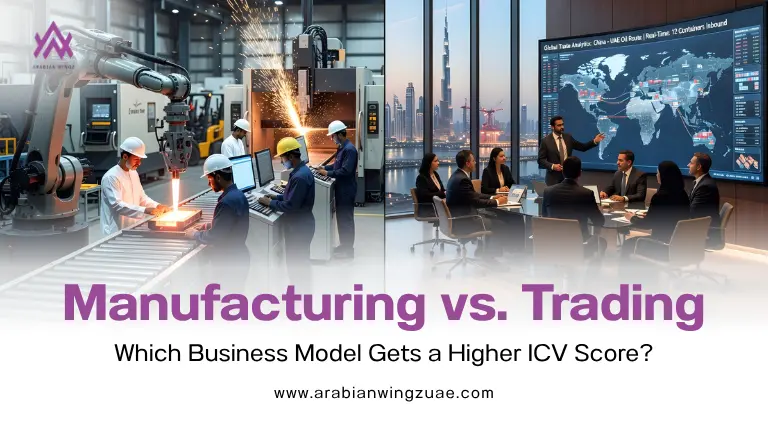
Regarding the ‘In-Country Value’ (ICV) score, manufacturing business models tend to receive higher scores compared to the trading models. The ICV formula highlights local production, fixed assets investment, and local procurement, signifying great benefits for manufacturing, as these elements are inherent to the sector.
In the UAE, the ICV score is crucial for measuring the contributions of a company to the local economy. Whether you operate in manufacturing or trading, your business directly impacts your ICV performance. But which model has the advantage? This blog breaks down this in simple terms with the impacts of manufacturing and trading on the ICV score, which one generates more ICV score, with reasons, and the role of ICV certification services in the UAE.

An ICV (In-Country Value) score is regarded as a metric of performance used to measure local economic contributions made by a company. In the UAE, the calculation of the ICV score depends on fixed asset investments, expenditures, Emiratization, and exports.
The ICV score acts as a benchmark for a company’s contributions to the local economy of the UAE. It is presented as a percentage, which is calculated from a company’s audited financial statements for the previous financial year.
Key Components of the ICV score:
The manufacturing and trading business have their own impacts on the ICV (In-Country Value) score. The ICV calculation formula is evaluated based on the expenditure on goods manufactured in the UAE, third-party spend, expats’ contribution, investments, and Emiratization.
Below is a table simplifying the impact of each (manufacturing (M) and trading(T)) model on the ICV:
| ICV Component | Manufacturing Model | Trading Model | Impact on ICV Score |
| Goods and Services Procurement | Large local sourcing of raw materials, packaging, and utilities. | High spend on imported finished goods (low ICV contribution) | Manufacturing > Trading |
| Manufacturing Cost | High impact: Direct labour, factory assets, depreciation, overheads. | Very low or none due to no local production. | Manufacturing > Trading |
| Third-Party Spend | Strong local subcontractor use (logistics, maintenance, and services) | More dependence on imported or external logistics. | Manufacturing > Trading |
| Investment in the UAE | High investment in factories, machinery, land, and technology. | Limited to office space and warehousing. | Manufacturing > Trading |
| Emiratization | Higher due to a larger and more diverse workforce’s needs. | Lower due to smaller workforce requirements. | Manufacturing > Trading |
| Expat Contribution | Higher local spending on housing, education, and services. | Lower due to fewer employees. | Manufacturing > Trading |
| Bonus Points | High potential (exports, advanced technology, investment growth) | Limited mainly to local sales activities. | Manufacturing > Trading |
The business model that receives a higher ICV (In-Country Value) score is manufacturing. In comparison to other business models, including trading, companies operating in the manufacturing sector gain a significant strategic, financial, and competitive edge in tender projects.
Here are the advantages they secure:



Here is why manufacturing models have a greater advantage in the ICV score:
As the manufacturing sector is dependent on the production of goods and services within the UAE, it gives an advantage to the companies due to localisation of spending for raw materials, labour, machinery, and facilities.
Manufacturers in the UAE prioritise local suppliers and subcontractors for the raw materials. This increases third-party expenditures,
In the UAE, manufacturers rely on the local suppliers and subcontractors for raw material supply and inventory. This increases their expenditures to the third-party within the nation.
The manufacturing sector involves a heavy dependence on fixed assets such as machinery, specialised equipment, facilities, and more. These fixed assets signify long-term investments in the local economy; therefore, increasing the ICV score.
Manufacturing operations require a skilled workforce to handle tasks efficiently, which includes technicians, engineers, helpers, and more. By hiring Emirati staff in the facility, these companies directly impact the local economy through job creation.
As companies manufacture goods in the UAE, they remove the dependence on imports. This directly signals their contribution to the local economy, resulting in a high ICV score.
ICV certification services in the UAE assist companies in complying with regulations and meeting the requirements of the National ICV Program, which was initiated by the Ministry of Industry and Advanced Technology (MoIAT).
In addition, many companies pursue ISO certification in Dubai or the UAE with an ICV score to strengthen both quality management and local economic contributions.
The role of the ICV certification services in the UAE:
When it comes to the ICV score, manufacturing companies have the edge over trading. It adds more local value to the ICV score through local production, Emiratization, fixed-asset investment, and local spending. Therefore, businesses that want to maximise their ICV score must consider investing in manufacturing and also acquire ISO certification in Dubai through expert ISO consultants in UAE to enhance credibility and compliance.
Here, we explored the definition of the ICV score, the impacts of manufacturing and trading on it, which one has the greater advantage and why, and how ICV certification services in the UAE can help in building a promising ICV score.
Arabian Wingz LLC is a trusted business setup and financial advisory firm in Dubai, assisting companies in acquiring ICV certification and improving their ICV score. Our experts guide businesses through the overall process, including compliance, audits, and strategic planning, along with several other solutions like ISO certification in Dubai and the UAE, ensuring a reliable and smooth process. So, contact us and get your ICV certification in the UAE today!
including compliance, audits, and strategic planning, along with several other solutions like ISO certification in Dubai and the UAE, ensuring a reliable and smooth process
Read More: What is ICV Certificate Dubai, UAE and How to Get It? Step-by-Step Process