FTA announces Corporate Tax Registration Deadline – 90 days from Date of Incorporation/MOA. AED 10k penalty for late registration.
FTA announces Corporate Tax Registration Deadline – 90 days from Date of Incorporation/MOA. AED 10k penalty for late registration.
FTA announces Corporate Tax Registration Deadline – 90 days from Date of Incorporation/MOA. AED 10k penalty for late registration.
The most important choice in your UAE expansion process is selecting the appropriate jurisdiction for your financial business. Although they serve different strategic needs, the two titans, ADGM vs DIFC, both provide top-notch regulatory environments.
It is crucial to comprehend the subtleties of DIFC company setup and the adaptability of an ADGM SPV, regardless of your preference for an established global hub or an affordable innovation laboratory.
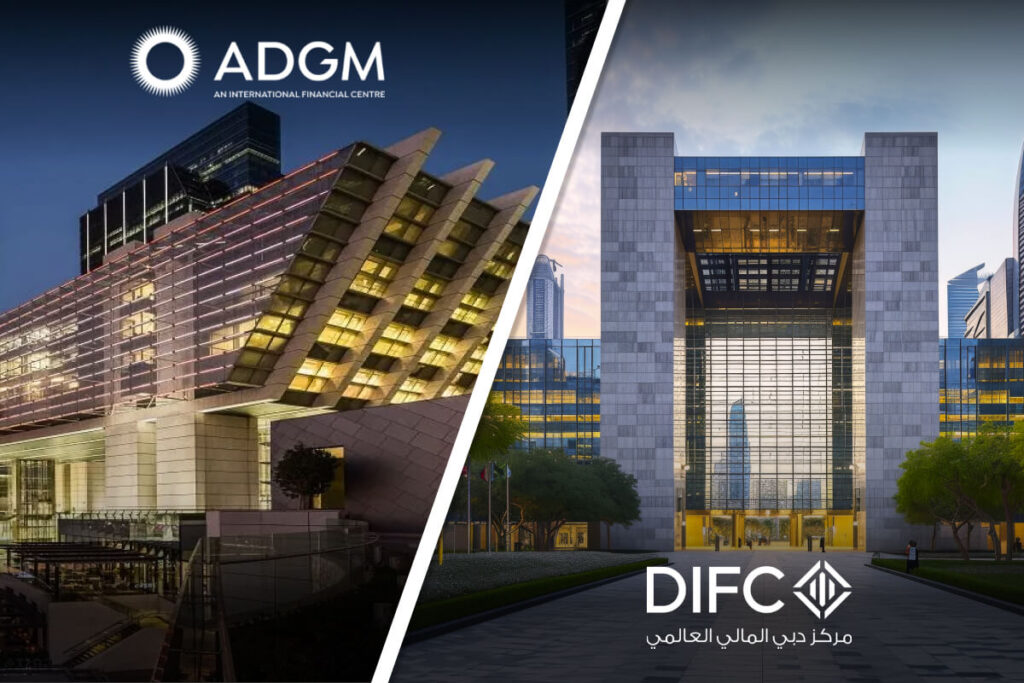
Abu Dhabi Global Market (ADGM) and Dubai International Financial Centre (DIFC) are referred to as “financial-free zones.” These free zones are similar to traditional parts of the UAE mainland but have their own distinct set of civil and commercial laws, which are based on English Common Law.
DIFC – Dubai International Financial Centre
Established in 2004 in the heart of Dubai City, DIFC has developed into the most established financial hub due to the concentration of banks, insurance companies, and wealth management firms found there; you will find the largest banking institutions in the world. If you want to have access to a well-established, quality bank, then look no further than DIFC.
ADGM – Abu Dhabi Global Market
Formed in 2015 on Al Maryah Island, Abu Dhabi City, ADGM is the newest financial free zone and has grown rapidly to be the most sought-after destination by tech startups, venture capital, and digital assets. The environment at ADGM is viewed as being friendly to innovation; they provide financial assistance for new startup businesses.



Comparing the DIFC with the ADGM is a useful exercise, not only in terms of the quality of both financial infrastructures, but also because DIFC vs ADGM are vastly different in terms of their personalities and styles of regulation. Below is a complete analysis of the key differences that will aid you in making the best decision for planting your business’s roots.
1. Founding and Reputation
The DIFC (Dubai International Financial Centre) is the very first financial free zone to open in the region, and since then, the DIFC has built enormous ecosystems, and the DIFC is known as the “Wall Street of the Middle East.” In contrast, the ADGM (Abu Dhabi Global Market) opened its doors to customers in 2015 and is working aggressively to position itself as the modern, technology and innovation-based, financial service provider, particularly as it relates to new developments such as digital assets.
2. Regulatory Authority
Both zones have their own independent regulatory authority. The Dubai Financial Services Authority (DFSA) is responsible for regulating DIFC-registered companies and has a rigorous compliance framework with very high standards that are consistent with what one would find in other global financial centres.
The Financial Services Regulatory Authority (FSRA) is responsible for regulating ADGM-registered companies. Both regulators have a strong reputation, although FSRA is often seen as being more agile in the creation of new financial service frameworks for FinTech and other innovative businesses.
3. Common Law and Legal Systems
Although both jurisdictions utilise English Common Law, they do so quite differently. DIFC has adopted an English principles-based “codified” version of that law by creating its own statutes based on those same English principles. Conversely, ADGM has adopted an English Common Law “direct application” of the law.
Many international attorneys find it simpler to navigate since the customary law applies more closely to London-based courts of law. Therefore, the certainty of the English Common Law towards its customary courts is attractive to foreign investors using an ADGM SPV to own high-value worldwide assets.
4. Targeting an Audience with a Specialised Focus
DIFC is the centre for HNWIs and institutional wealth; if your objective is to associate only with the world’s largest commercial banks, insurance companies, and hedge funds, then DIFC is your choice of location. By contrast, ADGM is preferred by companies focused on VC, start-ups, and cryptocurrency-related businesses. ADGM has many different styles of flexible structures, such as the ADGM SPV, which many people are using in establishing family offices and corporate structures.
5. Setup Costs and Accessibility
Overall, DIFC company setup will be more expensive than elsewhere due to the fact that it is in a great location and has already established itself as such. The costs related to renting space and obtaining licenses tend to be higher than in Abu Dhabi. ADGM has also been identified as having lower setup and operational costs than Dubai; generally, these costs are estimated at least 20% lower than in Dubai.
By working with a consultant such as Arabian Wingz, you can evaluate these costs, but it also gives you the best possible way to maximize your budget in finding the most efficient manner to achieve what you want.
The ADGM SPV is the industry leader for holding assets, protecting investments, and ring-fencing liabilities.
Reasons to use the ADGM SPV include –
1. Cost-effective – The set-up costs of an SPV in ADGM are much lower than a full operational license.
2. No office requirement – You do not require a physical office to operate through your SPV; you may use a registered office through a Corporate Service Provider (CSP), such as Arabian Wingz.
3. Flexibility – An ADGM SPV can hold property, shares in other companies, and/or intellectual property (IP).
4. Speed – Incorporating an ADGM SPV can typically be completed within a few days.

DIFC company setup is the “Gold Standard” of financial services. Although the bar is high, the benefits of institutional confidence are second to none.
The Setup Process
1. Define Your Activity – Define the type of activity that you will conduct – are you providing “Financial Services” (which are regulated by the DFSA) or “Non-financial Services”?
2. Regulatory Approval – You must undergo a thorough regulatory approval process with the DFSA if you will be a fund manager or a bank.
3. Physical Presence – Most DIFC entities also have a physical office located in the DIFC, as opposed to many SPVs.
4. Capital Requirements – Depending on your licenses, you may be required to demonstrate that you have certain levels of “paid up” capital (which can range from $10k for a license up to millions of dollars for banks).
There are many different answers to the question of which is the right option for you – the choice comes down to your own personal or business criteria and preferences.
1. Choose DIFC if – You want your business to have a presence within the international finance community located at “Gate Avenue” in Dubai. This can include banking institutions, large-scale private equity firms, or luxury wealth management companies that service high-net-worth individuals.
2. Choose ADGM if – You are an entrepreneur creating a sector within FintTech, a digital asset provider, or an equity partner that needs access to low-cost holding structures, such as an ADGM SPV with direct access to Abu Dhabi’s large sovereign wealth funds.
The regulatory/legal paperwork needed for these zones can be daunting! Here is how we act as your “Success Partner” to ensure your application is error-free from day one.
1. Strategic Advisory – Help you make the best decision on whether to establish your presence in the DIFC or in the ADGM based on your growth plan for the next five years.
2. Full Documentation – Create your Business Plan, AML Manual, and KYC documents.
3. Corporate Tax & VAT – Ensure your new company is compliant with the current corporate tax regimes in the UAE.
4. Banking Support – Assist you in completing the complex process of opening a corporate bank account in the UAE.
The DIFC vs ADGM provides a 0% tax environment, 100% foreign ownership, and the safety of English Common Law. While DIFC has the advantage of prestige, ADGM provides the speed of the future. If you have the right direction from Arabian Wingz, you can change the complicated regulations into a strong structure upon which to build your business.